Spoiler alert: Goaltending decides the NHL playoffs

The Stanley Cup Playoffs have delivered no shortage of irresistible storylines.
Here’s a few: the Vegas Golden Knights are a different team under new head coach John Tortorella. The Montreal Canadiens, Anaheim Ducks, and Philadelphia Flyers took major steps in their rebuilds. Mitch Marner and Taylor Hall have finally overcome the ghosts of playoffs past. The aging Edmonton Oilers and Tampa Bay Lightning couldn’t handle younger, fresher opponents.
These narratives may have some element of truth to them. But want to be let in on a little secret?
Goaltending decides nearly every postseason series. The stories we tell ourselves are mostly noise.
Whether a team has a reliable No. 1 goalie or some guy they didn’t trust two months ago. Whether a top seed or a team that squeaked into the playoffs. Whether fast or physical. Experienced or unseasoned. It’s a team’s goaltending performance that almost always settles the series. That’s it. That’s the secret.
🥅 The 2026 Postseason
Exhibit A: the last three playoff rounds.
Using game logs from HockeyStats.com, we can isolate Goals Saved Above Expected (GSAx) for each team’s goaltenders by series. Their model uses more than 50 features to establish how many goals an average goalie is expected to allow based on a game’s specific plays. A positive GSAx counts how many goals saved above expected; a negative GSAx reflects goals saved below expected.
Summarized below are the head-to-head goalie matchups through the Conference Finals. The GSAx figures reflect each team’s overall goaltending performance by series; the goalie listed is the one who played the most minutes.
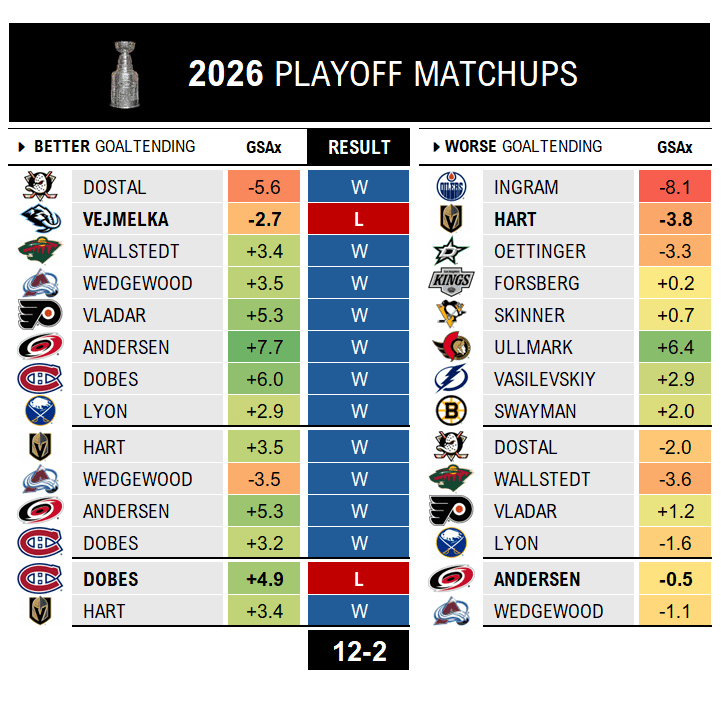
Through 14 series in 2026, the team that received better goaltending is 12-2.
There are only two exceptions:
- Vegas beat the Utah Mammoth in six games despite Karej Vejmelka (-2.7 GSAx) having edged Carter Hart (-3.8) in an uninspiring battle. Hart’s series remains third-worst of the 28 performances in 2026.
- The Carolina Hurricanes waxed Montreal in five games even though Jakub Dobes (+4.9) was exceptional against an average but untested Frederik Andersen (-0.5).
In every other series, the better team goaltending won. It’s not always great — or even good goaltending — that wins a series. A team’s goalie(s) just need to be better than the opposing team’s over a week or two to advance. The average Cup-winning goalie earned just a B-minus grade in this feature from a year ago.
But goaltending quickly shifts team narratives. Anaheim got a terrible showing from Lukas Dostal (-5.6), but Connor Ingram and Tristan Jarry were worse (-8.1). So, did the Ducks make a statement or luck into facing the worst goaltending in the postseason? Would the Habs’ outlook be as rosy had Dobes not summoned the spirit of Patrick Roy against both Tampa and the Buffalo Sabres?
GSAx, of course, is not a perfect measure. Timing and sequencing of saves matters. A few decimal points isn’t always Good vs. Bad. But it’s the best public measure available. 2026 is a docket of just 14 series — the proverbial small sample size — so let’s go back a little further to test the trend.
🥅 The 2022 to 2025 Postseasons
One year ago, we were preparing for a Cup rematch between Florida and Edmonton. Let’s check out the goalie results in 2025. Hint: the outcome looks awfully familiar.
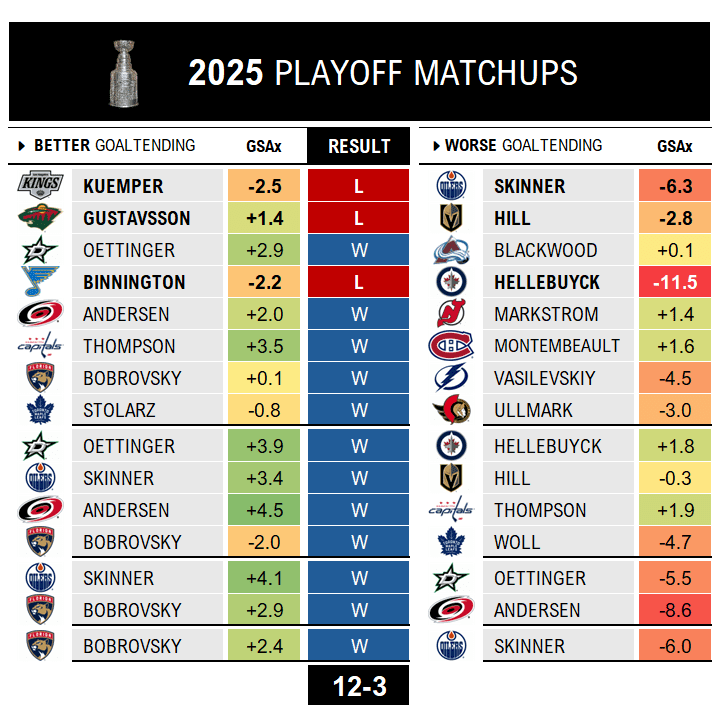
Overall, the teams that got better goaltending went 12-3 in 2025. The three teams that overcame weaker goaltending last year were all Round 1 mismatches. And let’s be honest: the Oilers could beat the Los Angeles Kings in cement skates at this point.
Going back further to 2022 — which covers 74 playoff series — the trend becomes crystal clear.
Postseason Record of Team With Better Series GSAx
| Year | Series Record | Winning % |
| 2026 | 12-2 | .857 |
| 2025 | 12-3 | .800 |
| 2024 | 9-6 | .600 |
| 2023 | 13-2 | .867 |
| 2022 | 13-2 | .867 |
| Total | 59-15 | .797 |
Over a half-decade, the team that got better goaltending has won 80% of all playoff series.
📢 Quieting the Narratives
Okay, we know goaltending drives the postseason bus. Get the weaker performance and your guys are likely booking tee times at their local country club. Let’s check in with Playoff Hero Mitch Marner (2026) — formerly known as Playoff Choke Artist Mitch Marner (2017-2025) — the living embodiment of our findings.
Marner had 11 dramatic, micro-analyzed, postseason series with the Toronto Maple Leafs. If you’re keeping score, Marner was mercilessly dubbed a loser nine times and reluctantly a winner just twice. Guess how many times Toronto got the better goaltending?
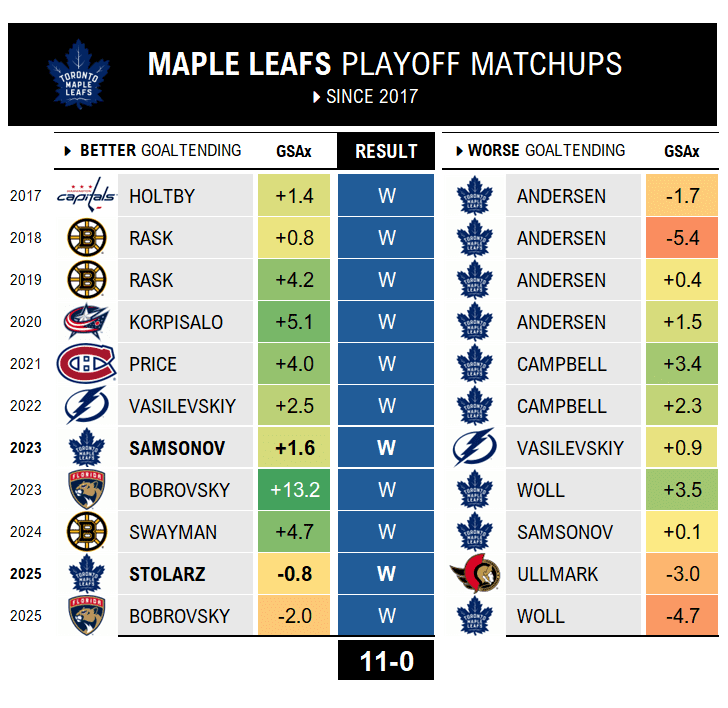
In the Marner/Auston Matthews playoff era, the team with the better goaltending went 11-0.
The only two times the Leafs had the goalie edge they won the series — Ilya Samsonov over Andrei Vasilevskiy in 2023 and Anthony Stolarz over Linus Ullmark in 2025. So many hot goalies terrorized Toronto over the years. Tuukka Rask. Joonas Korpisalo. Carey Price. Sergei Bobrovsky (+13.2 in 2023!). Jeremy Swayman. The Leafs went eight years without facing a goalie with a negative GSAx.
In total, goalies facing Toronto banked +31.6 GSAx versus +0.3 GSAx for Marner’s netminders. That’s a hopeless 2.8-goal handicap on average each series. I’m not saying Marner was great in those postseasons. Far from it. But had Toronto won the goalie battle more than twice in 11 tries, the entire plot probably would have shifted. The stench of six straight Round 1 exits would’ve dissipated. There’d have been less vitriol towards The Core Four. Every mistake wouldn’t have felt apocalyptic. Just look at what a couple of stolen series by Dobas has done for Montreal’s confidence.
In 2026, Marner’s Knights won Round 1 with shaky goaltending from Hart. But Hart’s since rebounded and outperformed both Anaheim’s and Colorado‘s goalies. It took nine years in Toronto for Marner to get better goaltending in two distinct series. In Vegas, he got that twice in three weeks.
💡 What are the Takeaways?
You might be thinking: we know goaltending is important. Thanks for your hard-hitting investigative journalism. But I’m not sure anyone realizes how critical it is to a team’s postseason fortunes. For every five series, four are won by the better goaltending performance. You have to badly outplay a team in the playoffs to lose the goalie war and emerge the winner today.
But what makes the takeaways so layered and fascinating is that playoff goaltending results are mostly… random.
#1. The goalies that lead teams to playoff success are totally unpredictable.
The eight second-round goalies in 2026 were journeymen, pariahs, and unproven gambles. With the exception of Dostal, any one of the guys below could have been on the bench to start the playoffs from a shaky two weeks in April or had a slightly hotter hand emerged. Lyon wasn’t even the starter for his team to open Round 1.
- Andersen: a 36-year-old with an .876 save percentage this season
- Dobes: a 24-year-old that wasn’t Montreal’s starter in October
- Dostal: a 25-year-old with no playoff experience
- Hart: did not play hockey last season
- Alex Lyon: a 33-year-old in his fifth organization with three career playoff starts
- Dan Vladar: a journeyman with no playoff experience
- Jesper Wallstedt: a 23-year-old with no playoff experience
- Scott Wedgewood: a 33-year-old journeyman that had never started a playoff game
Andersen was the only one that had more than one career playoff win entering the postseason. Yes, really. Martin Brodeur, these guys are not.
#2. The highest-paid goalies aren’t having playoff success.
The eight goalies above justify teams not drafting goalies high or committing dollars to the position. Just 20 goalies had cap hits of more than $5 million this season. The list of 20 is eclectic, from consistently elite (Igor Shesterkin, Vasilevskiy, Connor Hellebuyck, Ilya Sorokin) to solid starters (Jake Oettinger, Swayman) to the obscure (retired Carey Price, Elvis Merzlikins, Jarry). But only Dostal in an upset and Mackenzie Blackwood in a backup role saw second-round action.
You might be shouting: Sergei Bobrovsky won the 2024 and 2025 Stanley Cups with a $10 million cap hit! While they won’t admit it now, the Panthers would have dumped that contract many times before — if it were possible. Bobrovsky had even temporarily lost the crease to Lyon in 2023 at the beginning of Florida’s brilliant, three-year postseason run.
#3. Regular season performance has little correlation to playoff success.
The goalies thriving in the regular season aren’t thriving in the postseason.
A playoff series is a week or two of hockey against a random opponent. At a position with narrow margins and facing varying styles of play, the better goalies haven’t been the best goalies in quick sprints to four wins.
❓ What’s a General Manager Supposed To Do?
We’re in this weird bubble where goaltending is perhaps the most important factor to winning a postseason series… while also so random that teams are mostly refusing to make it a priority. Can you blame them?
Franchises are winning with no-name goalies and failing with brand-name versions. GMs are tying up cap space with goalies that don’t see the postseason and aren’t thriving if they get there. Meanwhile, thrift store options are winning rounds. A guy recently out of hockey facing jail time and a 36-year-old with more playoff scar tissue than Liam Neeson’s knuckles are dueling for a Stanley Cup. Their combined record is 24-5.
Shrewd front offices are doing what they should be: taking out the middleman. If goalies are unpredictable, don’t invest. Win the expected goals battle at 5-on-5 and you inherently lessen the impact of goaltending. It’s what the Hurricanes have done successfully for years. The Knights’ analytics were elite in 2025-26, but they have only now gotten serviceable goaltending at the right time. That’s the path many teams are wisely taking. If you fall into one of very few stud goalies, secure their services. Otherwise? Trust the team process and reduce goalie influence.
When we look under the hood, the resurrections of Marner and Tortorella in Vegas are directly connected to timely goaltending. It’s the same with Montreal’s deep run. When better goaltending wins 80% of the time, it’s a chilling reminder that every playoff team is a good or bad week of goaltending from a new narrative.
_____
Recently by Paul Pidutti
- This ‘Dogg’ won’t stop: Why Nathan MacKinnon is even more dominant than you think
- What can the modern history of No. 1 picks tell us about Toronto’s future?
- Father Time is the destroyer of playoff dreams
- The five trends that defined the 2025-26 NHL season
_____